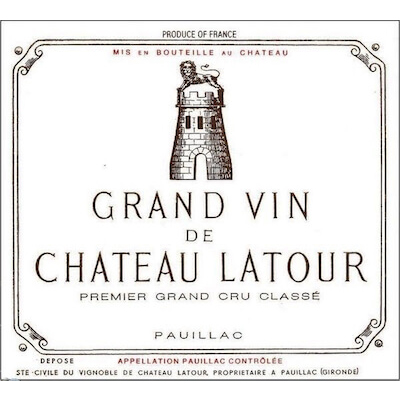




Latour
About Château Latour
Latour has, in many ways, always been the most forward-thinking and disruptive First Growth, ever since its original rise to prominence under the Ségur family in the 18th century. Its decision not to participate in En Primeur had a rippling effect throughout the fine wine world, and whilst it has not precipitated a broader move away from the system by other estates, the vast majority of Bordelais properties have certainly reduced the amount of their wine offered in this way choosing to hold back stock to be released upon maturity. A sign of Latour's influence upon the entire region.
The Vineyard and the Wine
There is an ancient Médoc saying - to make great wine, you must be able to see the water. No other First Growth is closer to the Gironde's estuary than this imposing estate, contributing to simply extraordinary terroir which means that Latour has an enviable (and uncanny) ability to produce outstanding wine in difficult years. In favourable years, the vineyard soaks up extra heat reflected from the water's surface. In unpleasant years, the property is protected from extremes by the moderating effect of the estuary's regulatory benefits.
This dream terroir allows the winemaking team to focus on a variety of aspects of viticulture safe in the knowledge that nature will see them through the worst - and focus they have! Ever the pioneers, Latour was one of the first châteaux to introduce cutting-edge processes such as satellite imaging of distinct plots, sensors assessing vine vigour and even wind-direction monitoring before the application of fully biodynamic treatments.
Château Latour has a distinctly high proportion of clay in the soil throughout its vineyard. Whilst unusual for Pauillac, it is, in fact, the very same clay upon which the vines of Château Pétrus are planted in Pomerol. Obviously found in far smaller quantities and dominated by glorious Left Bank gravel, the result of this composition is a wine of unfathomable texture, richness, concentration and spine-tingling freshness - for which Latour garnered the epithet "an iron fist in a velvet glove".

| Product Name | Region | Qty | Score | Price | |||||
|---|---|---|---|---|---|---|---|---|---|
|
|
Bordeaux | 1 | - | HK$16,195.00 | |||||
|
|
Bordeaux | 7 | - | HK$9,510.00 | |||||
|
|
Bordeaux | 1 | - | HK$20,000.00 | |||||
|
|
Bordeaux | 1 | - | HK$5,625.00 | |||||
|
|
Bordeaux | 3 | - | HK$5,880.00 | |||||
|
|
Bordeaux | 1 | - | HK$3,990.00 | |||||
|
|
Bordeaux | 1 | 89.0 | HK$3,905.00 | |||||
|
|
Bordeaux | 1 | 100 (VN (NM)) | HK$18,615.00 | |||||
Vinous - Neal Martin (100)What more needs to be said about the 1982 Latour? Tasted numerous times, this is the benchmark for the Left Bank. A heavenly nose of graphite-infused black fruit, so precise and focused, with an underlying seriousness that sets it apart from the other First Growths. The palate is utter class, regal and poised, with brilliant structure yet it is not oppressive. It just glides along with an almost crystalline, mineral-driven finish. Yes, perfection. Tasted single blind at the 1982 dinner at Cornus in London. |
|||||||||
|
|
Bordeaux | 1 | 90 (VN (NM)) | HK$5,140.00 | |||||
Vinous - Neal Martin (90)The 1985 Latour comes from a period where the First Growth was not firing on all cylinders. This offers black fruit laced with cedar and damp loamy scents, tertiary and a little smoky in style. The palate is well balanced though it does not deliver the complexity of a top Latour. There is gentle grip but it needs more finesse towards the finish. This bottle is actually better than others I have drunk in the past, but it's not a patch on the 1982 or 1990, also recently tasted. Tasted at the 1985 dinner at Noble Rot Mayfair. |
|||||||||
|
|
Bordeaux | 10 | 96 (WS) | HK$7,345.00 | |||||
Wine Spectator (96)Seems to be gaining in strength and depth. Incredibly rich, with meat, plum, cassis and tobacco flavors, harmonious, clean and long. Beginning to be approachable.--Latour vertical. Best after 2003. |
|||||||||
|
|
Bordeaux | 1 | 98 (WS) | HK$38,890.00 | |||||
Wine Spectator (98)Shows the ultraripe, exotic notes characteristic of the vintage, with roasted plum, tobacco and spicy flavors. It's beginning to evolve, but needs until 2000 to really come together.--Latour vertical. |
|||||||||
|
|
Bordeaux | 1 | 98 (WS) | HK$5,910.00 | |||||
Wine Spectator (98)Shows the ultraripe, exotic notes characteristic of the vintage, with roasted plum, tobacco and spicy flavors. It's beginning to evolve, but needs until 2000 to really come together.--Latour vertical. |
|||||||||
|
|
Bordeaux | 1 | 90 (WS) | HK$9,255.00 | |||||
Wine Spectator (90)Outstanding quality from a weak year. Good darkruby color. Intense aromas of chocolate, berry andcedar. Full-bodied, with firm tannins and a longfinish. Starting to show some bottle bouquet, butgood backbone and firmness. Textbook Latour from adifficult vintage.--Latour vertical. Best after 2004. -JS |
|||||||||
|
|
Bordeaux | 1 | 94 (WA) | HK$9,455.00 | |||||
Wine Advocate (94)This is an interesting as well as great vintage for Latour. As indicated in my barrel tasting report, Latour's 1994 possesses an atypically high percentage of Merlot (27%) in the final blend. Because of this, the wine appears to have a sweeter, more fleshy texture than is typical for a young Latour, but do not make the mistake of thinking this will be a commercially-styled, easy to drink wine. It exhibits an opaque dark ruby/purple color, and a backward, intense textbook nose of walnut and cassis scents complemented by smoky pain grille notes that build in the glass. This full-bodied, powerful, layered Latour reveals high tannin, but no bitterness or astringency. The superb purity, fabulous precision, and remarkable length should ensure 35-40 years of longevity. Readers will find more fat, flesh, and glycerin than usual for a young Latour (save for such great vintages as 1982 and 1990), but don't be deceived, this wine requires 8-10 years of cellaring. Anticipated maturity: 2005-2035. Last tasted 1/97 |
|||||||||
|
|
Bordeaux | 1 | 94 (WA) | HK$4,055.00 | |||||
Wine Advocate (94)This is an interesting as well as great vintage for Latour. As indicated in my barrel tasting report, Latour's 1994 possesses an atypically high percentage of Merlot (27%) in the final blend. Because of this, the wine appears to have a sweeter, more fleshy texture than is typical for a young Latour, but do not make the mistake of thinking this will be a commercially-styled, easy to drink wine. It exhibits an opaque dark ruby/purple color, and a backward, intense textbook nose of walnut and cassis scents complemented by smoky pain grille notes that build in the glass. This full-bodied, powerful, layered Latour reveals high tannin, but no bitterness or astringency. The superb purity, fabulous precision, and remarkable length should ensure 35-40 years of longevity. Readers will find more fat, flesh, and glycerin than usual for a young Latour (save for such great vintages as 1982 and 1990), but don't be deceived, this wine requires 8-10 years of cellaring. Anticipated maturity: 2005-2035. Last tasted 1/97 |
|||||||||
|
|
Bordeaux | 11 | 97 (DC) | HK$5,781.00 | |||||
Decanter (97)The nose showed warm and sunny, baked black and red fruit on the nose and a supple but dense texture. The impressive level of tannin noted in earlier tastings is softening now, and the wine is ready to drink but will hold. A lovely wine, outperforming the 1996 at this point. Picking was finished in September, taking place from the 13th to the 27th. The final blend is nearly three-quarters Cabernet Sauvignon, with just a drop of Cabernet Franc, and Petit Verdot and Merlot for the balance. |
|||||||||